Collaborate and grow
Encouraging entities to commit to continuous up-skilling, and working with multi-disciplinary teams.
Creating a Stakeholder Map helps teams visualize the complete ecosystem of a service.
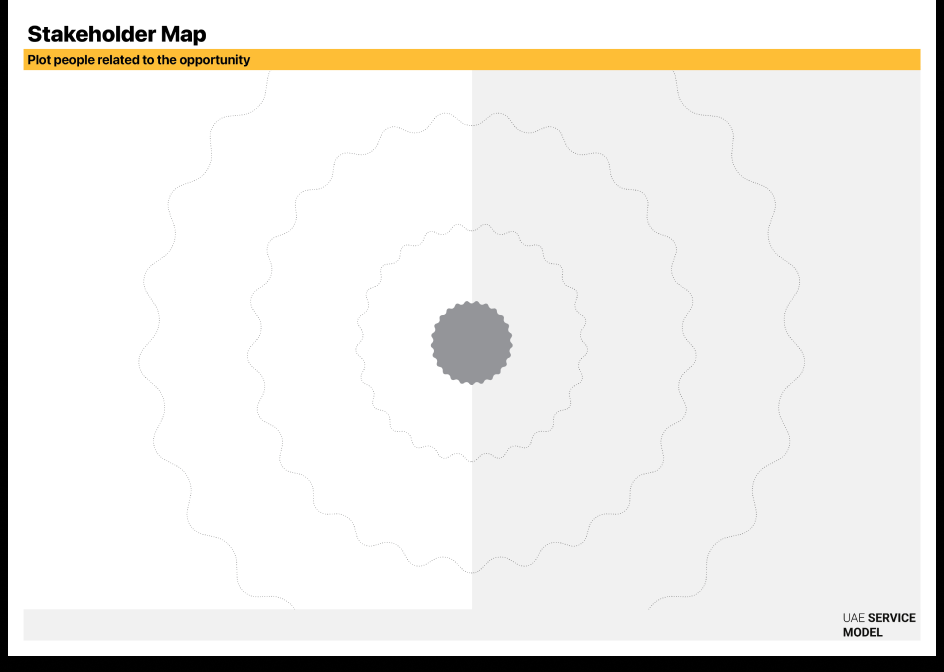
Creating a Stakeholder Map helps teams visualize the complete ecosystem of a service. It goes beyond listing names to mapping the relationships, dependencies, and power dynamics between every entity involved . In a modern government context, "stakeholders" are no longer just people. They include digital systems, AI agents, external data providers, and regulatory algorithms. This tool provides the clarity needed to navigate these complex networks, ensuring that technical partners, frontline staff, and policy makers are aligned to deliver an integrated, AI-ready service.

1–2 hours (per service or project)

Beginner – Intermediate

Discover & empathy

None, you can use it at any time

Stakeholder Map template (digital or printed), sticky notes or digital tags

Cross-functional team (service designers, project managers, policy makers, IT leads, frontline representatives, external partners)
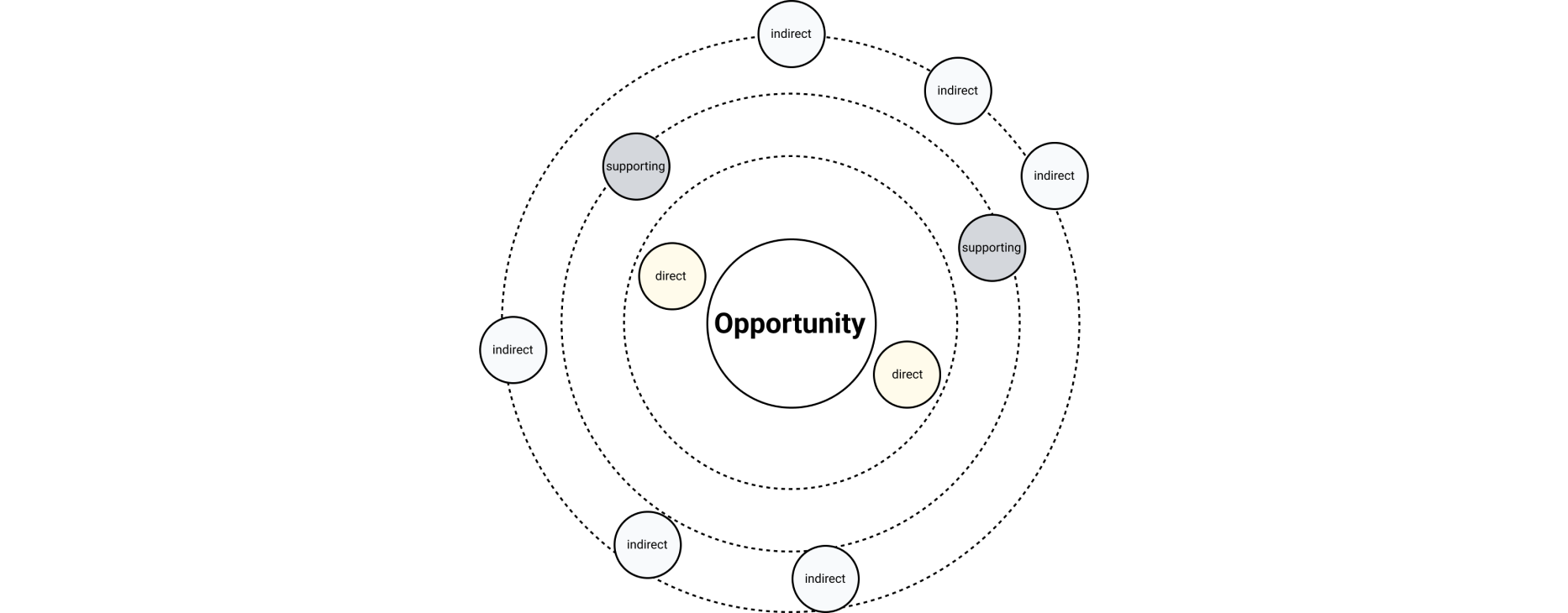
Start by writing the opportunity or project focus in the center of the map.
List everyone connected to the challenge, including Frontline Staff and Technical Partners (API Providers) — users, employees, departments, vendors, partners, regulators, and others affected by or influencing the service.
Place stakeholders on the map based on their level of involvement or influence:
Inner circle: Primary users and directly involved actors
Middle circle: Supporting departments or collaborators
Outer circle: Indirect influencers or external entities
Draw connections between stakeholders to show relationships, dependencies, or communication flows. Note key collaboration points or potential conflicts.
Discuss who holds decision power, who provides input, and who experiences the outcomes. This helps clarify governance structures and identify gaps in communication or accountability.
Based on the map, agree on engagement approaches — who to co-create with, who to consult, and who to keep informed throughout the design process. For Frontline Staff stakeholders, plan co-design sessions early to test operational feasibility.
Use the “reframing the challenge” QR code to uncover “hidden opportunities” or hidden actors by asking the AI to list stakeholders from a systemic or regulatory perspective that you might have missed.
Stakeholder Discovery: Describe your service concept to an AI tool and ask: "List all potential regulatory bodies, private sector partners, and internal departments in the UAE that would be impacted by a service involving [Topic, e.g., Autonomous Drones]."
Stance Prediction: Feed public statements or reports from a specific stakeholder (e.g., a regulatory authority) into an AI and ask: "Based on these documents, what would be this stakeholder's primary concern regarding our new AI-driven service?"
The lines between stakeholders are more important than the dots. Look for broken lines where two departments should be talking but aren't.
Update the map as the project evolves — new actors often emerge as services move from design to implementation.
In modern services, a "Legacy Database" or an "AI Algorithm" can be a stakeholder that dictates rules. Consider mapping them to understand technical constraints.
The "Proactive Health" Ecosystem Scenario: The Ministry of Health is designing an AI-powered service that uses data from citizens' smartwatches to detect early signs of diabetes.
Mapping the Three Levels (Human & Non-Human)
The Inner Circle: The Citizen (User) and the Wellness Nurse.
The Middle Circle: The Wearable Device Vendor (who owns the API) and the AI Risk Engine (a non-human stakeholder that "decides" who is at risk).
The Outer Circle: The Data Privacy Office and International Data Laws.
Creating the map completely shifted the team's strategy.
Realizing Hidden Influence: They discovered that the Data Privacy Office (Outer Circle) held more power than the Ministry itself. If this stakeholder wasn't engaged immediately to define data consent rules, they would likely block the service at launch.
Understanding Complexity: They realized the project wasn't just a "medical app" but a complex legal partnership. The map highlighted that without a formal agreement with the Wearable Vendor (Middle Circle), the service had no data to run on. Result: Instead of starting with app design, the team prioritized a legal workshop with the Privacy Office and the Vendor, saving months of wasted development work.
The map revealed that the "Data Privacy Office" and "Wearable Vendor" were critical but disconnected
stakeholders. Realizing this, the team prioritized Collaborate & Grow, breaking down silos to engage these partners early in the legal and technical definition phases. This cross-sector collaboration was essential to navigate the complex regulatory landscape and deliver an integrated AI service.
Our design principles that relate to stakeholder map.
Our service principles that relate to stakeholder map.