Measure success
Best practices for developing meaningful measurement.
The Validation Guidelines help teams test and refine solutions through direct user feedback.
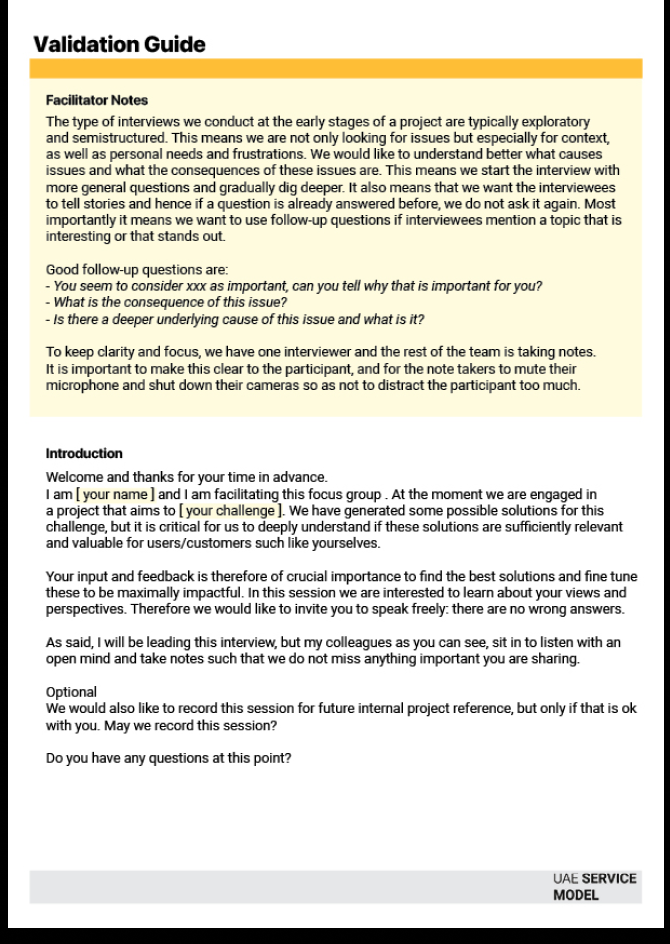
The Validation Guidelines help teams test and refine solutions through direct user feedback. By using structured interviews and focus group discussions, teams can evaluate whether proposed solutions meet user needs, align with operational realities, and deliver measurable value. This process ensures that ideas are validated by real users before scaling or implementation, reducing risk and improving the quality and adoption of the final service.

60–90 minutes per validation session

Intermediate

Testing & validation

Prototype, concept card

Prototypes or scenario mock-ups, Validation Guide, note-taking templates, ranking sheets, recording tools (optional)

Facilitator, 1–2 note takers, 4–6 users or stakeholders per session, frontline employees
Before the session, define your goal — whether to test relevance, usability, or value.
Prepare 2–3 realistic scenarios or prototypes representing your proposed solution.
Assign one facilitator and one or two silent note-takers to maintain focus and minimize distraction.
Welcome participants and explain the purpose of the session:
“We’re exploring whether the ideas we’ve developed truly address your needs. Your honest feedback will help us refine and improve them.” Clarify that there are no wrong answers, and obtain consent if recording.
Present each scenario clearly — one at a time — and use open-ended questions to explore:
Do you recognize this situation or need?
How often does it happen and what is the impact?
What are your first thoughts about this solution — what works well, what doesn’t, and why?
How do the proposed benefits resonate with you?
(For staff participants) Is this solution operationally feasible? Does it fit into your current workflow or create new friction?
Encourage participants to share personal stories or examples; probe deeper with follow-up questions like:
“Why is that important to you?”
“What would make this easier or more useful?”
Ask participants to rank the presented scenarios from most to least valuable from their perspective. Discuss their reasoning — what makes one idea stronger or weaker.
Summarize what has been learned and thank participants for their time and input. Close by asking:
“Would you be open to joining another session when the improved solution is ready?”
Real-Time Synthesis: Use AI transcription tools during validation sessions to tag "Positive" vs. "Negative" feedback in real-time, giving you an immediate sentiment score for the concept.
Objection Handling: Before the session, describe your concept to an AI and ask: "Act as a skeptical user. What are the top 3 objections you would have to using this service?" This prepares your team for the hard questions.
Go beyond surface feedback to understand if users find the solution meaningful and worth adopting.
This helps maintain consistency and focus during sessions.
Capture emotions and context — not just yes/no answers.
Explore the “why” behind each opinion.
Summarize user reactions, key patterns, and improvement areas immediately after each session.
Include both frontline employees and end-users to assess operational feasibility and customer experience together.
A digital service team tested a new appointment scheduling platform for health clinics. Through validation interviews, they discovered that while users appreciated the convenience, many frontline staff found the system lacked flexibility for last-minute changes. By incorporating both user and staff feedback, the team refined the scheduling logic to allow easy rescheduling and priority tagging.
The result: a 30% reduction in missed appointments and higher satisfaction for both patients and staff.
Our design principles that relate to validation guidelines
Our service principles that relate to validation guidelines