Think big
Bold, creative, and outside-the-box thinking.
The Opportunity Card is a strategic alignment tool used at the beginning of a project
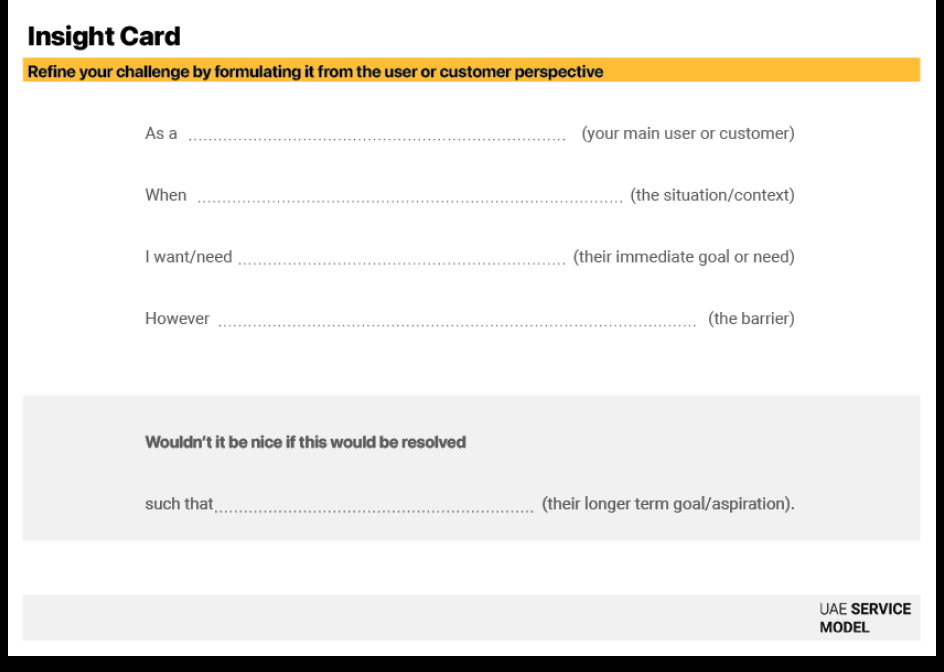
The Opportunity Card is a strategic alignment tool used at the beginning of a project. It helps teams define and prioritize areas for improvement and innovation before generating specific solutions. This tool bridges the gap between "What do users need?" (Existing information) and "What are the government's goals?" (Strategy). By explicitly linking user benefits to organizational KPIs on a single page, it helps teams validate whether an opportunity is worth pursuing and ensures that any future solution delivers value to both the public and the organization, thereby creating clarity and alignment upfront.
15–30 minutes for preparation (Product Owner), additional 15–30 minutes for team alignment
Intermediate – Advanced
Definition & strategy
User info and strategic directions
Opportunity Card template, Research Insights, Strategic Government Goals
Cross-functional group (service designers, product owners, organization analysts, leadership representatives)
Write a single sentence describing the aspirational future state. What is the ultimate goal we want to reach?
Describe the strategic gap or goal for the entity. What problem is the government trying to solve? (e.g., high costs, low compliance, slow processing).
Define the User Benefit: Describe the value for the citizen. What need or pain point are we addressing for them? (e.g., saving time, reducing anxiety, increasing access).
List specific, measurable indicators that show success for the entity (e.g., % reduction in manual work, budget savings).
List metrics that prove value to the user (e.g., satisfaction score, ease-of-use rating).
Use the completed card to secure buy-in from leadership before starting design work.
KPI Generator: Input your strategic goal into an AI tool (e.g., "We need to reduce operational costs for visa processing") and ask: "Suggest 3 quantitative organisational KPIs and 3 qualitative user impact metrics to measure success in this area."
Opportunity Refinement: Feed your draft "Organizational/Strategic Opportunity" and "User Benefit" text into an AI and ask: "Critique this proposition. Is the link between the organizational goal and user benefit logical and strong?"
Perspective Shifting: Use the "Reframing the Challenge" QR code to help view your strategic goal from multiple perspectives (user vs system) and generate stronger propositions that balance organizational and user needs.
A good opportunity must score high on both sides. If it serves the organization but offers no real benefit to the user, adoption will fail.
Avoid vague goals like "Improve happiness." Use "Reduce wait time by 50%".
If you have 5 different directions you could take, make 5 cards. The comparison makes it clear which opportunity offers the best return on investment.
Ideally, use real data to ground your vision. However, if you must start with assumptions, ensure they are clearly marked and prioritized for further research and validation.
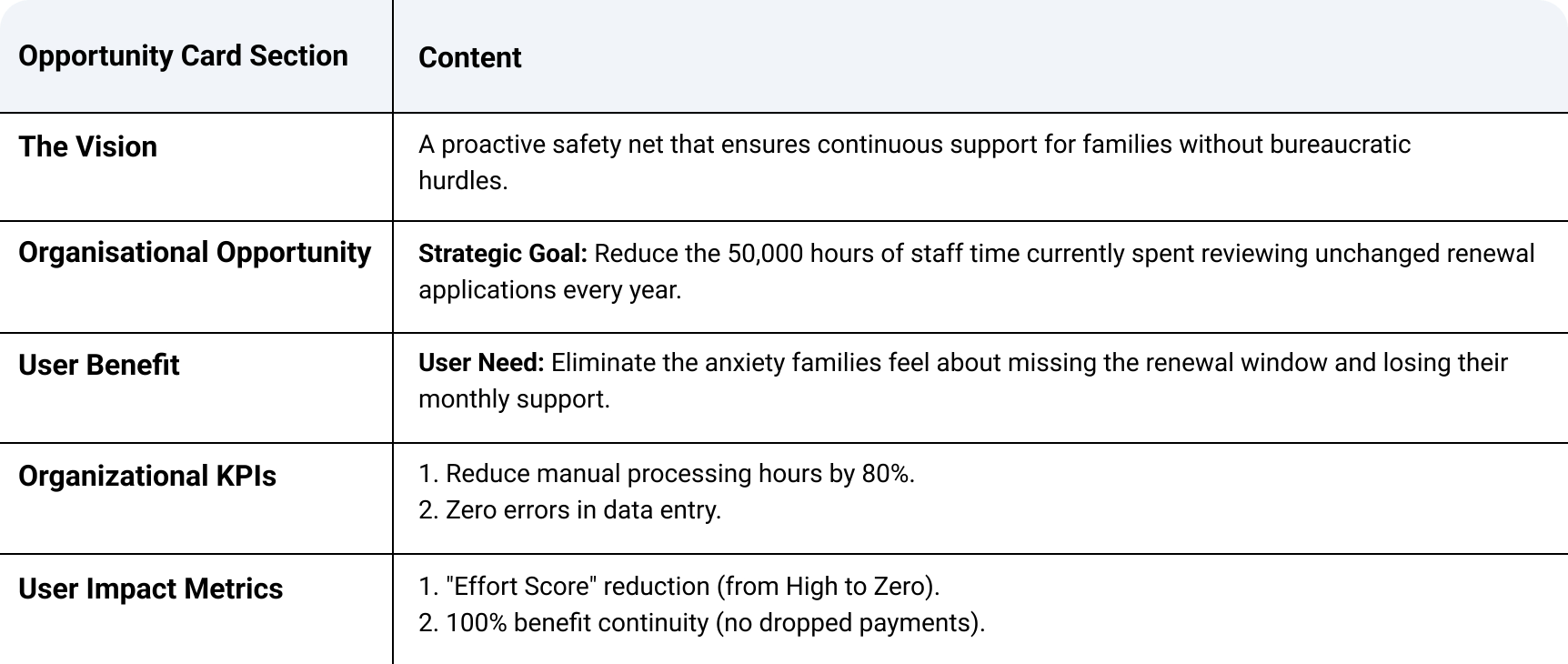
The "Zero-Touch" Renewal Scenario: A government entity is exploring ways to improve the annual renewal process for social benefits.
The Context: The entity has a strategic direction to "Reduce Administrative Burden." Research shows users are stressed about annual deadlines.
Using the Tool: The team uses the card to define the opportunity space before deciding on a solution (e.g., a website vs. automation).
Our design principles that relate to opportunity card.
Our service principles that relate to opportunity card.