
Automation Technologies
Leverage automation technologies to drive further efficiency.

Standard and advanced technology can contribute to efficiency
One of the central elements of driving efficiency is the adoption and integration of automation technologies.
These have the potential to revolutionise the way governments operate, making them more responsive, accurate, and cost-effective.
Standard automation
Robotic Process Automation (RPA) helps automate repetitive and routine tasks in government processes, such as data entry, document processing, and form-filling, freeing up time for public servants to focus on more strategic tasks.
The Australian Taxation Office (ATO) integrated RPA into their systems to automate time-consuming and repetitive tasks. Bots were employed to extract and consolidate data from various sources, validate information, perform calculations and update records. This significantly reduced processing times, improved data accuracy, and enhanced overall efficiency in handling tax related tasks.
Real automation
Machine Learning advanced algorithms derive complex insights and identify patterns, empowering decision-making and helping workers move faster with their activities.
Blockchain enhances transparency, security and efficiency of transactions and record-keeping.
Artificial Intelligence aims for improved customer experience but also drives enhanced operational efficiency, freeing up workers to focus on more important tasks.
The US Citizenship and Immigration Services (USCIS) department has witnessed improved efficiencies after leveraging an AI-powered virtual agent named Emma, which answers basic questions and helps users navigate the website while human experts support with individual, more complex demands.
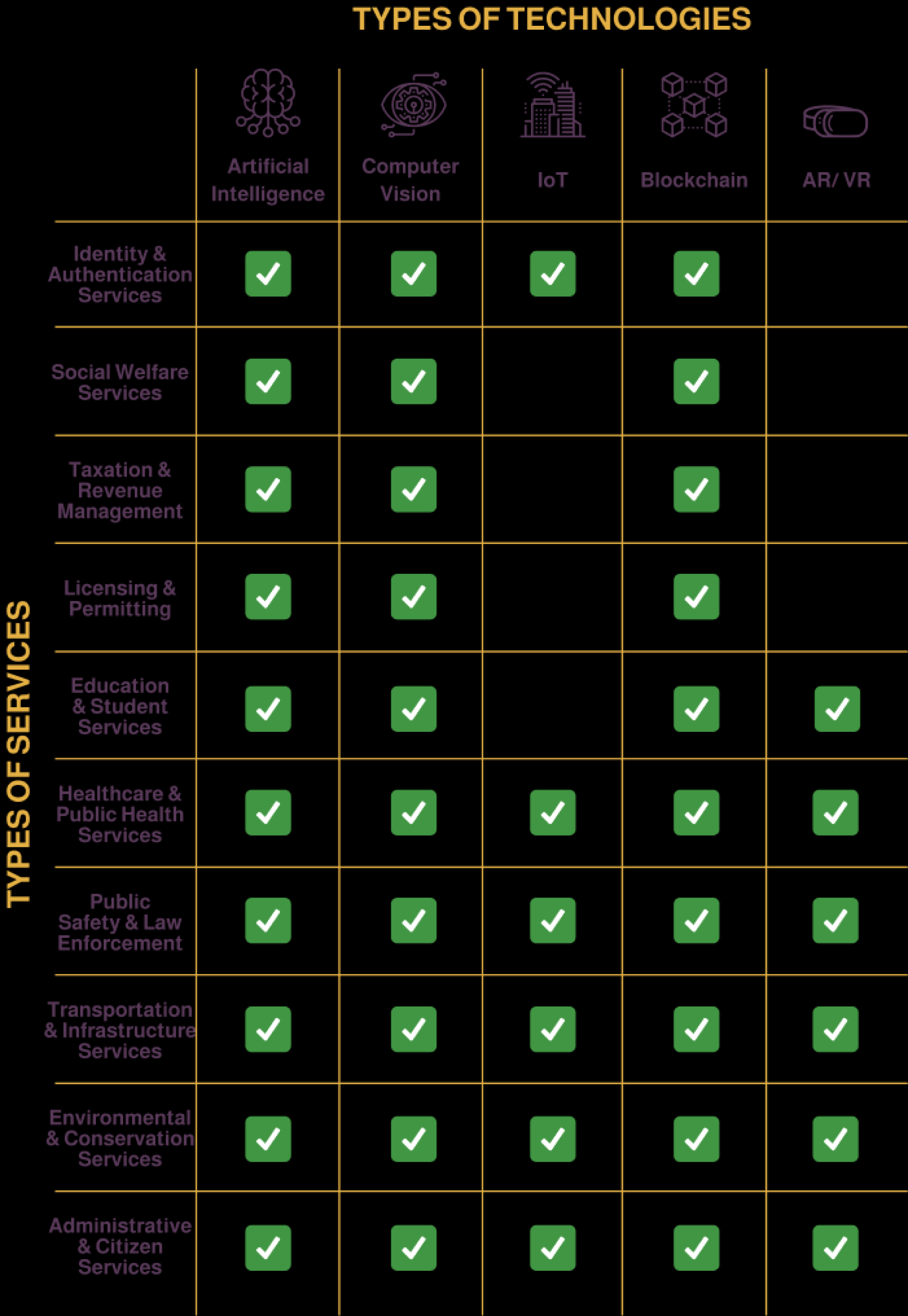
Real automation technologies most relevant to government services
Artificial intelligence
Analyse data, learn patterns and make decisions without human intervention. Machine Learning, Deep Learning and Natural Language Processing are some of the subfields of AI. Widely used in government services for data analysis, decision-making, pattern recognition and predictive analytics.
Computer vision
Enables machines to process visual data allowing them to recognise people, objects and actions. Can be used in security and surveillance applications, such as facial recognition and license plate recognition, to enhance public safety and law enforcement.
Internet of things
Be integrated into smart city infrastructure to enable real-time monitoring and control of traffic, public utilities, and other public services. IoT can also help in disaster management, environmental monitoring, and energy management.
Blockchain
Improve transparency, security, and efficiency in various government services, such as land registration, voting, supply chain management, and identity verification.
AR / VR
Transform various aspects of government services by providing immersive, interactive and engaging experiences.