
Automation requirements, challenges and risks
Preempt top implementation challenges and risks that might arise.

Identify key requirements to enable real-automation
Successful real-automation adoption requires a set of foundational elements related to government, people and technology
Government
Governance
Clear governance model (e.g. data) with stakeholders involved.
Policy and regulatory framework
Alignment with relevant policies and regulations.
Collaboration and partnerships
Across entities, as well as with private sector partners, academia, and others.
Technology
Data management and analytics
Efficient collection, storage, organization, integration and use of data (e.g.,quality, privacy and security, accessibility, interoperability) - Data gaps management (e.g., external third parties, proxies, synthetic data development).
IT infrastructure and technology
Modern infrastructure and tools required to ingest and process data (e.g., cloud computing coupled with robust cybersecurity).
Performance monitoring and evaluation
Framework to track projects and refine them as needed.
People
Leadership buy-in and vision
Strong leadership with top- down sponsorship to drive adoption and maturity. - Clear vision and strategy, aligned with the broader government’s strategy, coupled with an action plan (e.g., real-automation roadmap) that includes goals and milestones dependent on the budget. - Change management strategy (e.g., support to reskill and upskill employees).
Collaborative and entrepreneurial mindset
Cross-entity alignment and collaboration (e.g., data sharing culture) - Culture that believes in failing fast, putting fear aside and experimenting.
Team with the right capabilities
Task force to drive the strategy and roadmap under leadership - Specific roles, responsibilities and skills development at different levels (e..g, trainings, pod team per use case combining functional/ industry and technical competencies).
Institute for Public Management and Economic Development (IGPDE), offers training courses (E.g., Artificial intelligence, data science: New economic challenges) to equip public servants with basic knowledge about AI and its opportunities and challenges.
AI workshops open to public officers and, in particular, middle and senior managers, to increase digital literacy and provide foundational knowledge about the potential of AI for public work and public organizations.
Preempt top implementation challenges that might arise
Some of the common pitfalls that typically inhibit the ability to quickly adopt and deploy real- automation

Lack of effective cross- entities collaborations, between functional / industry and technical teams.

Sourcing high quality data and processing, especially with limited data sharing culture.

An omnichannel approach can provide a more personalised and responsive customer service experience, as interactions are tracked across channels, and information is shared seamlessly between service representatives.

Employees will feel more empowered in their jobs, as they are working within a system based on multiple channels that are robust, flexible, and effective.

By tracking interactions across channels, an omnichannel approach can provide citizens with greater visibility into the status of their requests or applications.

An omnichannel approach can improve the collection of data and feedback from citizens, which can help agencies improve their services and make data-driven decisions.
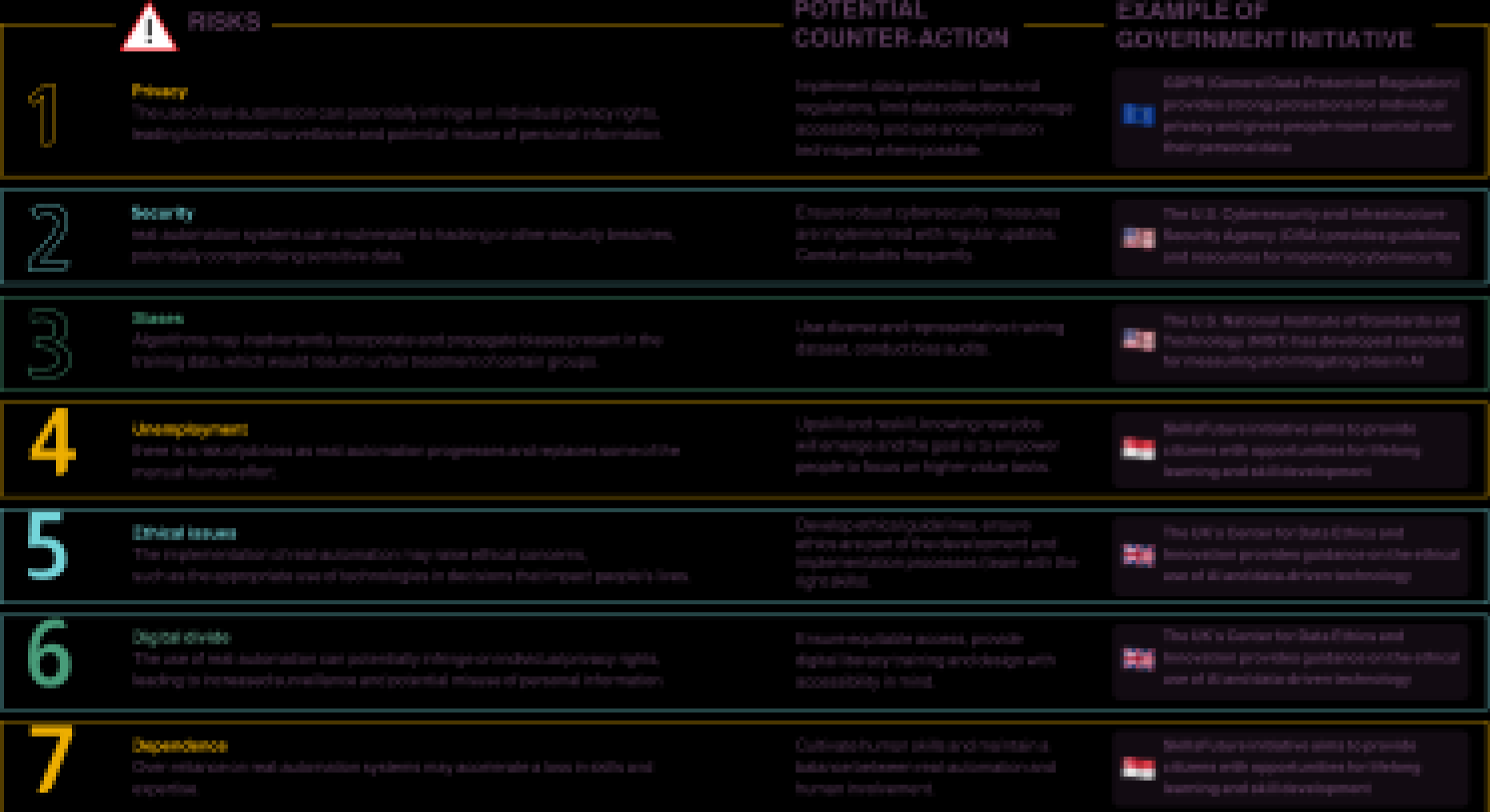
Enforce safeguards and anticipate potential risks associated with real-automation
Despite real-automation’s potential to unlock transformative services, governments will have to identify and manage multiple risks that those new technologies pose to make sure their deployment is ethical and human-centered.