Agile ways of working
Implement agile cycles and use tools to deliver user-centered services efficiently.

Ways of working
Development is broken down into time boxed iterations named “Cycles” (1-4 weeks each).
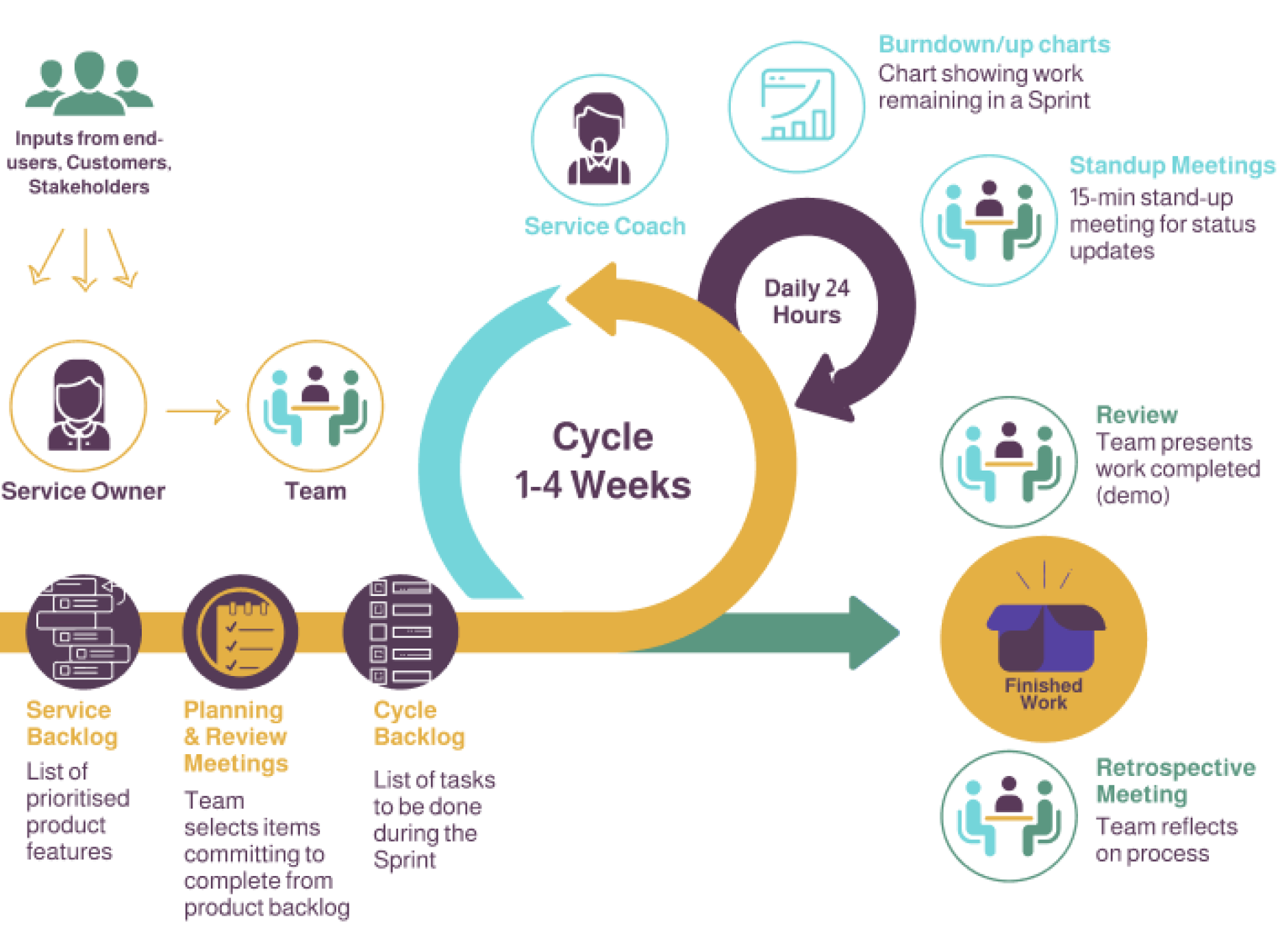
In addition to roles and ceremonies, Agile projects include certain tools and artefacts. The most common are:

Helps visualise sprint backlog and typically includes post-its on a whiteboard (to-do, WIP and done).

Teams breakdown features requirements into “user stories” that describe what customers want.

Set period of time that a team works towards completing a goal.

User stories recorded but not moved to development, are stored in the icebox.

Teams typically leverage project management (e.g., Jira or Trello), or collaborations (e.g., Slack, confluence) tools.
User stories
User stories should be specific, concise, and include all necessary details. Vague or incomplete user stories can lead to confusion or misunderstandings among the team members and may result in incomplete or incorrect development.
“As a user, I want a better interface for the website.”
This does not specify customer's goal for improving search functionality. Vague about customer's objectives and reasons for better search functionality.
"As a user, I want a more intuitive and user-friendly interface for the website.
Specifically, I want the menu bar to be more visible and easier to navigate, with clear labels and descriptions of each menu item.
This will help me find the information I need more quickly and efficiently and make my overall experience on the website more enjoyable.”
Time boxing
Timeboxing requires clearly defining the start and end times of a task or activity. If these boundaries are not defined clearly, it can lead to confusion and misunderstandings about what is expected during the timeboxed period.
A government agency set a three-month timebox to implement an online application for a license, but the team didn't consider the integration time needed. Thus, the project took five months to complete.
A more effective timeboxing approach involves ensuring a thorough understanding of project dependencies and requirements upfront. This enables setting a realistic timeframe and adjusting as needed to meet deadlines and budget. Iterative development and testing methods can further detect and address issues early in the project.
Ice boxing
Iceboxing should focus on high-level priorities and should not get bogged down in details. Focusing too much on details can lead to wasted time and effort, and can distract from the most important tasks.
The goverment agency's new online platform neglected to prioritise essential features and functionalities critical to the user experience, opting to defer them to a later release. This proved to be a costly mistake, as citizens were left dissatisfied with the platform and the agency had to spend additional resources to implement the missing features after the platform's launch.
A more effective iceboxing approach for government services involves a prioritisation framework considering citizen needs, agency goals, and strategic priorities. This ensures critical features are prioritised in the initial release, while lower priority items are deferred. Regular review and reassessment of priorities aligns with evolving citizen needs and expectations.