Agile roadmap
Develop an agile roadmap to achieve faster launch times.

Benefits of an agile roadmap
While multiple cycles can go on in parallel to design several features of a product / service, it is imperative to have a product roadmap to prioritise the delivery of the most important features over the rest. Having a product roadmap helps align stakeholders, prioritise features, provide a timeline, create flexibility, aid with resource planning, and build confidence in the team’s ability to deliver the product or service.
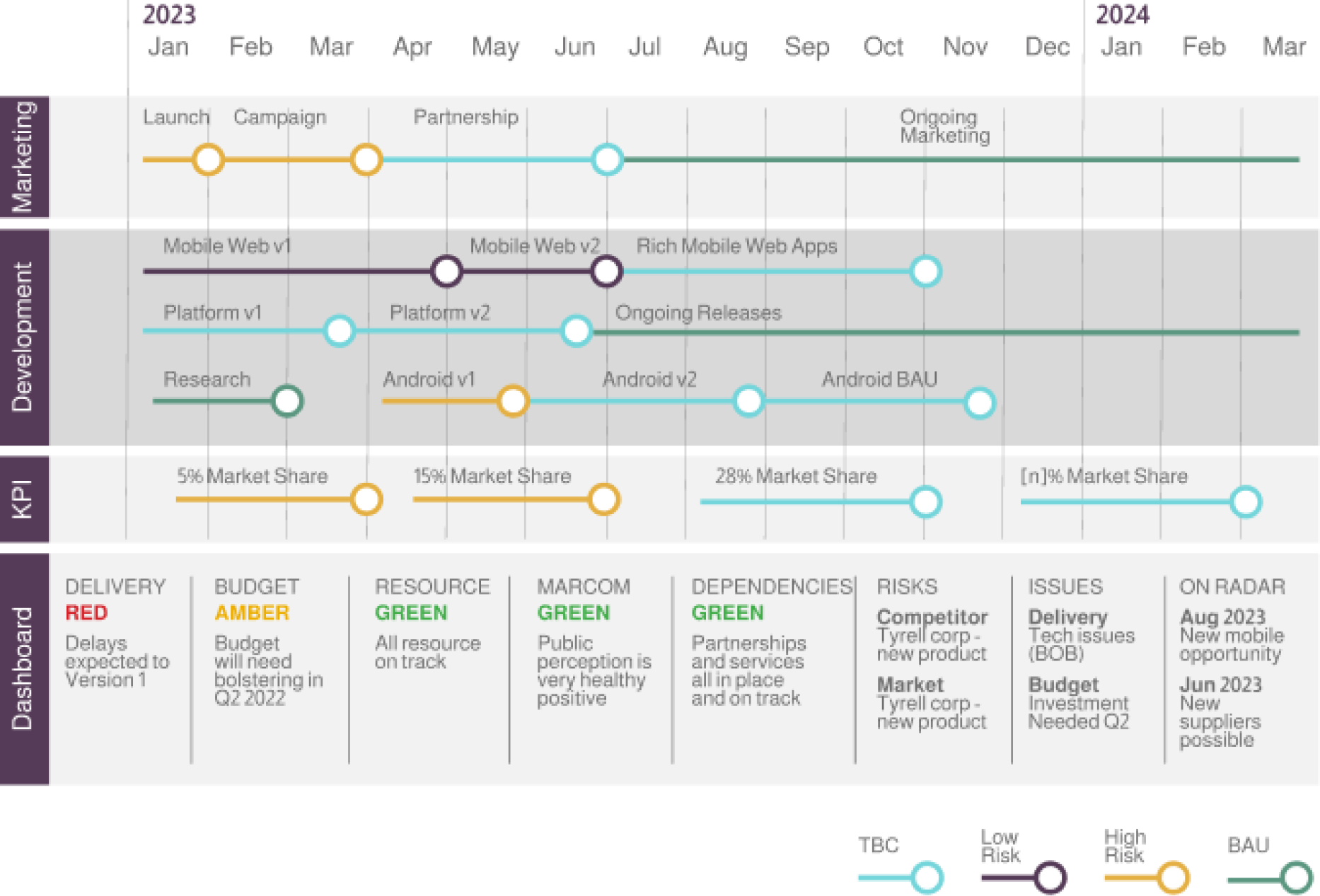
Example of an agile roadmap:
Guidelines to building an agile roadmap

Clarify overall vision and objectives (specific, measurable, attainable, relevant and time-bound), as well as outcomes and deliverables.

Identify high-level initiatives linked to objectives and prioritise them (impact, value, dependencies).

Break each initiative into smaller units of work. Epics are large features, user stories are specific, actionable and can be tested independently.

Assess effort for each user story using a relative scale (e.g., story points). Prioritise based on value, dependencies and risks (e.g., MoSCoW, Eisenhower).

Visualise roadmap in time (spreadsheet, project management or roadmap tools). Allocate epics/ user stories to sprints. Keep roadmap flexible.

Take into account team’s capacity and external constraints or dependencies (e.g., resource availability, reliance on external stakeholder).

Share roadmap and obtain feedback (e.g., Roadmapping workshop).

Through sprints, review and update roadmap based on feedback, new insights and changing priorities.